There is a great deal of pride in reflecting on the work being done in our 7th – 12th grade building around literacy interventions and support for our special education staff and students. Our teachers, coaches, and administrators are working incredibly hard to rectify an unfortunate reality: 34% of our students are not proficient readers, according to the Iowa School Performance Profile.
The Reading League Iowa recently hosted a DDIA (Decoding Dyslexia Iowa) Conference Recap event. During the recap, board member Rhonda Nelson shared data from a session hosted by Travis Wilkins, ADM assistant superintendent. Wilkins shared the following:
According to the spring 2025 ISASP results, 27% of Iowa 3rd – 11th graders are not proficient in reading/ELA. That means 95,057 students in the state of Iowa are not proficient readers. That is an entire population, spread across the state, that cannot successfully pull knowledge and meaning from text. This is certainly not unique to Fort Madison, or to Iowa, or to the United States.
As good as I feel about the work being done in our very own 7th – 12th grade building, we are barely making a dent in addressing the problem here, let alone across the state and the nation. This will continue to be the case until we truly and whole-heartedly and 100% take a deep dive into working to systematically address the problem.
There are a growing number of evidence-backed resources to support system-wide efforts. Currently, three books top my list of such resources:
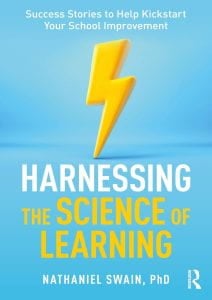


Yet these resources and efforts are often ignored. They are ignored for a host of reasons: lack of awareness of the resources, falling back on old habits, not capitalizing on the strengths of the people within school systems, or failure to commit to an initiative for the long-haul.
Implementation science is an area worth focused attention (I think this one may be joining the science of reading, the science of teaching, and the science of learning!). This six-minute video from the National Implementation Research Network, NIRN, describes the factors necessary for improved learning outcomes using the “Active Implementation Formula.”
The formula, “Effective Practices x Effective Implementation x Enabling Context = Socially Significant Outcomes” is detailed below:
- Effective Practices – using Evidenced-Based Practices (EBP’s), that are:
- teachable
- learnable
- doable
- assessable
- Effective Implementation – working through the stages of implementation:
- Exploration
- Installation
- Initial Implementation
- Full Implementation, with implementation drivers including:
- Competency of staff
- Organization processes & procedures within the school system
- Use of EBP’s with fidelity
- Enabling Context – establishing necessary structures:
- Implementation teams with a common goal of improving student outcomes committed to the use of
- Improvement Cycles of “Plan, Do, Study, Act”
- Educational environments committed to supporting all staff and students
The Active Implementation Formula, when viewed through a math lens, demonstrates that when any of the factors are not 100% in place, the intended results (improved learning outcomes) will not be achieved.

I’ve seen this play out time and time again over my 29+ years in education: professional development is provided around an effective practice, but only some of the effective practice is utilized. Effective implementation doesn’t occur because personal philosophies butt-up against evidence, while accountability and coaching support are not in place, so only some classrooms implement the effective practice. The enabling context, with a clearly outlined Improvement Cycle, is not in place or is not fully carried out. We beat our heads against the wall because, yet again, socially significant outcomes are not achieved.
I believe some call this the definition of insanity: doing the same thing over and over again while expecting different results. Put another way:

It is fairly easy to understand why so many initiatives fail: the work is NOT easy.

The work is not quick.

The work is exhausting; it is not about adult comfort.
But the work is worth it. We are in the business of education because we recognize that the desired results are achieved with collective and collaborative efforts. We are in the business of education because we believe that ALL kids can learn at high levels. We are in the business of education because we believe in the moral and ethical call to do what is right by all kids.
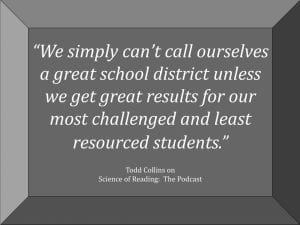
The data on proficient readers is depressing.
I commend you all for the hard work you are putting in.
I hope higher ed is paying attention so we get teachers who are prepared to implement research-based instructional methods.
In the meantime, it is a marathon, not a sprint, for administrators and teachers who all need to be on the same page.