The EDVIEW360 podcast from Voyager Sopris recently released a stellar episode featuring two of education’s greats: Dr. Anita Archer and Dr. Louisa Moats. The world is a better place because of these two individuals. Their work has resulted in and will continue to result in high levels of learning for teachers and students everywhere. I may sound hyperbolic, but there is no exaggeration here.
I frequently catch myself wanting all of the answers when it comes to effective reading instruction, even though I know better. All of the answers don’t exist. The mythical silver bullet is just that: mythical. The science of reading is an ever-evolving body of knowledge… which is a beautiful thing! The June 22nd EDVIEW 360 podcast episode was a reminder that if the amazing Dr. Anita Archer and Dr. Louisa Moats, at ages 76 and “a bit older than that,” are still learning, then we are ALL still learning.
About 15 minutes into the episode, Dr. Moats said that after a conversation with Anita, she has days of processing all that she has learned. Dr. Archer added, ” I mean, we just had a discussion last week that made me spend three days on an answer.” Isn’t that great… and something to hold close to our hearts?! These reading experts are nowhere close to thinking they have all of the answers. It brings to mind a favorite quote from Dr. Julie Washington:

The biggest take away from this episode is this: The Science of Reading x The Science of Teaching = Proficient Reading. I can’t help but steal the idea behind Gough and Tunmer’s Simple View of Reading equation to illustrate what Dr. Archer and Dr. Moats so beautifully express.
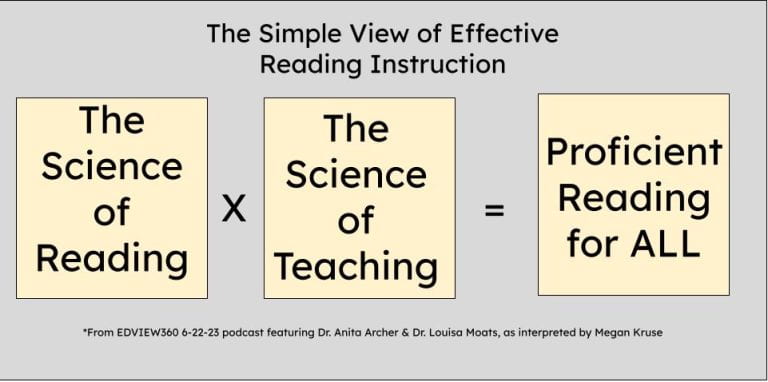
We will not get the literacy outcomes we so desire if we rely solely on the ever-evolving body of knowledge that is the science of reading. That body of knowledge is vast, long-standing, ever-evolving, and critical to effective literacy instruction. But it is not enough. It must be married to the science of teaching. As expressed by Dr. Archer, “The science of teaching is more important than the science of reading.” To which podcast host Pam Austin responds, “It’s a body of knowledge that carries over to other areas beyond reading.”
The science of teaching has not received the attention that the science of reading has in the past several years, but it is a long-standing body of knowledge, coupled with the science of learning, that has the impact on student learning that we all so desire. When I think of the science of teaching, I first think of John Hattie’s work. Hattie’s Visible Learning identifies those teaching practices, proven through meta-analysis of thousands of studies, that have the most significant impact on learning. He identifies 0.4 as the “hinge point,” – the point at which we would say, (In Dr. Archer’s words) “Let’s do it.”
Dr. Archer’s Explicit Instruction is must-have for understanding how to apply the science of teaching. In this fabulous must-have for all teachers, we are reminded about the importance of explicit instruction with carefully, logically sequenced content and carefully-planned scaffolds. We are reminded to ensure ample opportunities for students to respond. From Chapter 6, “Whether you are teaching a large or small group, you must elicit frequent responses by requiring students to say, write, and/or do things. If instruction is truly interactive and students are constantly responding, then attention, on-task behavior, and learning increase, and behavioral challenges decrease.” And all is done with a perky pace. 🙂
The science of reading movement continues to gain traction and has made major gains in improving literacy instruction with a focus on systematic and explicit reading and writing instruction. However, as Dr. Moats points out in a February article, “Without systematic, explicit, cumulative teaching of the lessons, however, the impact of the content will be diluted… Developing expertise in lesson delivery and evaluation is a long-term but very rewarding undertaking which will transform the science of reading into ‘success for all.’ It’s time to capitalize on the science of teaching.”
I eat, breathe, and sleep the science of reading. But, the science of reading isn’t enough. Teachers are implementing SOR ideas and activities without effective delivery methods. Marrying the two sciences (reading and teaching) is where the magic happens! Of course, many other factors play into high levels of learning for all: high quality curricular materials, instructional coaching support, teacher efficacy, and robust systems that employ MTSS (Multi-tiered systems of support).
As Dr. Archer and Dr. Moats remind us: nothing is easy about it – not near enough credit is given to the hard work that teachers must do to achieve high levels of learning. Podcast host Pam Austin sums it up beautifully: “…reading truly is complex, and often, we like to press the easy button. With reading, we cannot press the easy button. Developing teachers, design, delivery, dedication but dedication to teaching in the manner that’s going to ensure that our students gain knowledge in the end…”
It certainly is NOT easy. And as we are reminded with more and more frequency: we cannot do this work one classroom at a time. This requires a systems change (see reference above to MTSS). The remarkable Stephanie Stollar reminded us of just that at the first ever Iowa Science of Reading Summit held in Iowa City at the end of July. The event was fabulous and deserves a post or two of its own. In the meantime, as the 2023-2024 school year fast approaches, I am more energized than ever to roll up my sleeves and work as a cog in the system that will change literacy outcomes for all of our students, because in the words of Stephanie Stollar: